Planning Efficiency
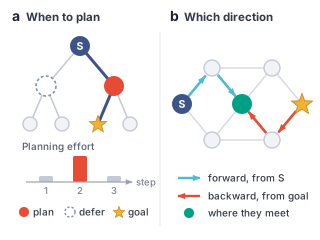
Planning is powerful but costly, so efficient decision makers must decide when and how to plan. One route is timing: in two preregistered studies, people learned to defer planning until it was needed, guided by a cognitive map of the task rather than by trial and error (Sharp & Eldar). Another route is direction: people adaptively plan forward from where they are or backward from their goals, choosing whichever predictive representation is more efficient in a given environment (Sharp & Eldar, Nature Human Behaviour). Ongoing work extends this to healthy aging and anxiety.
Offline Learning
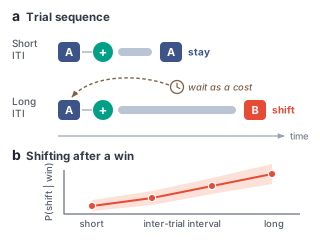
We learn quickly from few experiences partly through offline learning: using memories and a model of the world to simulate actions and outcomes, for example between decisions or during rest. In work in progress presented at the 2026 Computational Psychiatry Conference (Best Poster Award), we asked how the few seconds between choices shape learning. Rather than consolidating what was just learned, longer inter-trial intervals made people more likely to abandon an option that had just paid off, across four studies including two preregistered replications, as if the wait were a cost charged to that choice (Yadid, Linkovski & Sharp).
Task (Mis)construal
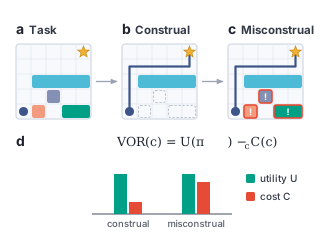
Planning relies on an internal model, or construal, of the task. We propose that anxiety distorts these construals, leading to excessive planning, re-checking of decisions already made, and poor generalization (Sharp, Trends in Cognitive Sciences). Recent work shows that worry predicts undergeneralizing actions learned under threat (Schiff & Sharp, Topics in Cognitive Science), that people keep pursuing punishment-avoidance goals the task no longer requires (Sharp et al., eLife), and that worry is linked to excessive model-based revaluation.